
When Tencent Silenced Call of Duty Online to Feed Mobile
Tencent shut down Call of Duty Online in China, funneling players into Call of Duty: Mobile. Data erased; accounts gone.
In the summer of 2021, Tencent did not merely close a video game. It turned off a virtual country. Call of Duty Online, the free-to-play PC shooter that had lived in China since 2015, was scheduled to go dark on August 31. The announcement arrived through a blog post from the game's team, which explained that an agency contract had expired. Industry analyst Daniel Ahmad added a colder subtext: declining revenue and a lack of renewal interest from Activision had sealed the fate. The message to players was clear—march toward Call of Duty: Mobile.
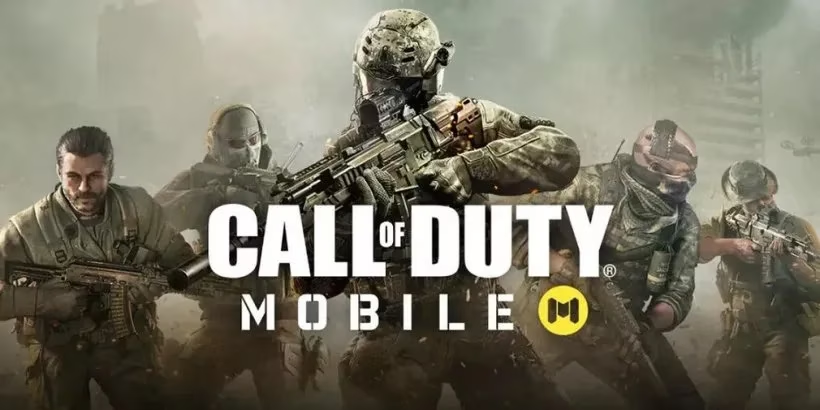
For six years, Call of Duty Online had been a strange, successful hybrid: a PC-only free-to-play shooter built for China, stitching together maps and weapons from across the Call of Duty franchise. It was a paper crane folded from old war maps—beautiful, intricate, and easily crushed by a contract's expiry. For a while, it worked. Then the seams began to pull. CoD: Mobile had launched only a year earlier, in 2020, as a free-to-play mobile game with a similar content framework. The parent company did not need two children competing for the same dinner table.
A Farewell Paid in Gift Packs
Tencent offered a compensation event. It was not a hero's send-off but a bureaucratic mercy: gift packs designed to replace any unused virtual currency sitting in player accounts. The gesture had the awkward tenderness of a landlord returning a security deposit after demolishing the building. Players could visit the official website to learn how the transition would work between Call of Duty Online and CoD: Mobile. Then, after August 31, the lights would go out. Tencent would erase all player data, and the game would no longer be playable.
That erasure is the part that lingers. A server shutdown is one thing; a data wipe is another. It is like a sand mandala being swept into the ocean by a janitor who has no interest in symbolism. Every customized loadout, every unlocked weapon, every match history—gone. The game became a house with no doors, still standing in memory but impossible to enter.
The Migration Machine
Call of Duty: Mobile was waiting. It was not a direct sequel; it was a lifeboat lowered from a sinking ship. The mobile title offered the same broad promise—free-to-play, familiar maps, familiar guns—but in a form that fit into a pocket. For Tencent, the math was simple. A PC game with declining revenue and an expiring contract could be sacrificed so that a mobile game with a wider reach could grow. It was less a murder than a planned succession, executed with corporate calm.
Daniel Ahmad's analysis framed the closure as a business decision, and it was. But for players, the shutdown felt like something else: a border closing overnight. One day they could log in; the next, their account was a ghost town. The compensation event was meant to soften the blow, but gift packs cannot replace a community. They are like giving someone a bouquet of flowers after their garden has been bulldozed.
2026: The Dust Has Settled
By 2026, the shutdown of Call of Duty Online is a historical footnote. Call of Duty: Mobile has become a permanent fixture in the mobile shooter landscape, and the idea of migrating players from PC to mobile no longer raises eyebrows. The industry has learned the same lesson again and again: live-service games are not owned by their players. They are rented, and the lease can end with a blog post. The old PC client is now a museum piece, its servers cold, its data erased, its final months preserved only in forum threads and YouTube videos.
Yet the story remains instructive. It shows how a game can be fairly successful and still be disposable when a contract expires and revenue dips. It shows how compensation can be both generous and hollow. And it shows how a player base can be redirected like a river into a new channel, not because the water chose the path, but because the engineers did.
Tencent did not kill Call of Duty Online out of malice. It closed a chapter to write a more profitable one. The players who loved it were left with gift packs, memories, and a mobile game that asked them to start over. In the end, the shutdown was a quiet, corporate thing—but it landed on the community with the weight of a tombstone.
Now, in 2026, the only way to play that old game is to remember it. And memory, unlike a server, does not come with a shutdown date.
Data referenced from Esports Charts helps contextualize why Tencent’s decision to sunset Call of Duty Online in favor of Call of Duty: Mobile followed the industry’s gravity toward scalable live-service ecosystems: when attention, viewership, and competitive engagement concentrate around the most accessible platforms, older region-locked PC services become harder to justify once contracts lapse and revenues soften.