
Italian Watchdog Investigates Diablo Immortal & COD Mobile for Aggressive Monetization
Activision Blizzard faces a groundbreaking Italian Competition Authority investigation in 2026 for alleged misleading and aggressive practices in mobile gaming, spotlighting urgent ethical concerns.
Hey everyone, buckle up because we've got some serious gaming news hitting the scene in 2026. The Italian Competition Authority, basically the big watchdog over there, has just launched a major investigation into Activision Blizzard. And the targets? Two of the biggest mobile games on the planet: Diablo Immortal and Call of Duty: Mobile. They're being accused of some pretty heavy stuff – using what they call "misleading and aggressive practices" to squeeze more playtime and, more importantly, more money out of players. As someone who's spent more hours on my phone than I'd like to admit, this really hits close to home. It feels like the conversation around "ethical" game design, especially for mobile titles, is finally reaching a boiling point with regulators stepping in.
🔍 What Exactly Are They Accused Of?
So, what's the big deal? According to the official statement, the Italian authorities are digging into how these games are fundamentally structured. They claim the entire experience is engineered to push players into a cycle of constant engagement and spending. It's not just about having microtransactions; it's about how they're presented and pushed on you. The report highlights a few key tactics that sound all too familiar to any mobile gamer:
- Deceptive UI & Constant Prompts: The watchdog points to "the possible use of deceptive user-interface design." This means prompts that pop up everywhere – during gameplay, on the main menu, even via push notifications when you're not playing. The message is always the same: "Don't miss out!" on some limited-time reward or offer. It creates this artificial sense of urgency and FOMO (Fear Of Missing Out) that's incredibly hard to ignore.

-
Obfuscated Currency & Bundles: This is a classic, and one I've personally fallen for. The investigation notes that it's often difficult for players to understand the real value of the in-game currency. How many "Gems" or "COD Points" does a dollar actually get you? It gets even murkier with the sale of currency in "bundles" that don't translate to clean, real-world prices. You end up spending more just to use up the odd amount of currency left over from a bundle purchase.
-
Default Parental Controls That Don't Protect: This might be the most alarming part. The report states that the parental control settings in both games default to options that offer "a lower level of protection for minors." By default, these settings allow in-app purchases, social features, and even "unlimited play time.\" Parents who aren't super tech-savvy might think they've set up a safe environment, but the games are starting from the most permissive stance possible. That's a huge red flag.
💰 The Psychological Hook: How It Gets You
Let's talk about the psychology behind this, because that's really what the investigation is about. It's not just selling digital hats; it's about manipulating player behavior. The authority's statement puts it bluntly: these practices "may influence players as consumers—including minors—leading them to spend significant amounts, sometimes exceeding what is necessary to progress in the game and without being fully aware of the expenditure involved."
Think about it. A timed pop-up for a "legendary weapon pack" that disappears in 2 hours. A login streak that resets if you miss a day. A battle pass that constantly shows you the cool rewards you haven't unlocked yet. These aren't accidents; they're carefully tuned systems designed to trigger our brains' reward centers and aversion to loss. For younger players who might not fully grasp the value of money or the tactics being used, the impact can be even greater. It shifts the focus from "having fun" to "keeping up" and "not missing out," which is a fundamentally different, and often stressful, way to experience a game.
🛡️ The Data Privacy Angle
But wait, there's more! The investigation isn't stopping at monetization. The Italian Authority also wants to scrutinize how these games collect personal data. They raised a specific concern about the consent screens players see when they first boot up the game. The allegation is that the design "seems" to lead consumers, including minors, to select all consent options—including consent for commercial profiling—because the interface makes it look like a mandatory choice to proceed.
You know the screen: a wall of text with checkboxes and a big "ACCEPT ALL" button that's much more prominent than the "customize" or "reject" options. It's dark pattern design 101, and if you're just a kid (or an adult in a hurry) trying to play the new Call of Duty map with your friends, you're probably just smashing that big button to get into the action. This means potentially handing over a lot of data without truly informed consent.
🏢 The Bigger Picture: Activision Blizzard & Microsoft
This is all happening under the new ownership umbrella of Microsoft, following their historic $75.4 billion acquisition. It puts Microsoft in a tricky spot. They now own these massive franchises and their associated business practices. The gaming community and regulators alike will be watching closely to see how Microsoft responds. Will they defend the existing monetization models, or will this investigation prompt a wider review and change in design philosophy across their newly acquired mobile portfolio? It's a huge test for their commitment to what they've called "responsible gaming."
🎮 Meanwhile, In Better Gaming News...
While this serious regulatory battle unfolds, it's a good reminder that there are countless amazing games out there that respect your time, your wallet, and your intelligence. You don't need manipulative loops to have a deeply engaging experience. Just look at the incredible puzzle games we have in 2026! These are titles built on clever design and pure satisfaction, not FOMO.
Here are some absolute gems that prove you can have a blast without feeling pressured:
| Game Title | Why It's Awesome |
|---|---|
| Blue Prince | A mysterious, ever-changing mansion to explore. Every run is different! |
| Outer Wilds (Timeless Classic!) | Unravel a solar system's secrets through knowledge, not upgrades. A masterpiece. |
| Return of the Obra Dinn | A detective puzzle where you piece together a ship's fate. Unique and brilliant. |
| Tetris Effect: Connected | Pure, undistilled puzzle bliss with amazing music and visuals. Therapy in game form. |
| The Talos Principle 2 | Philosophical first-person puzzles that make you think about... everything. |
| Baba Is You | A game where you rewrite the rules themselves. Mind-bendingly creative. |
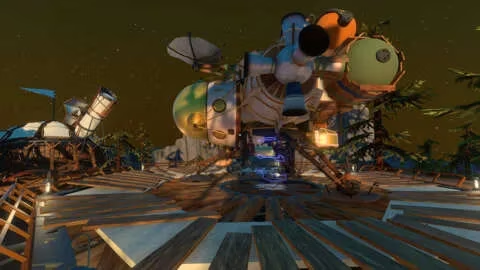
Games like Blue Prince offer deep engagement without predatory tactics.
Outer Wilds remains a benchmark for respectful, player-driven discovery.
✍️ Final Thoughts
Look, I get it. Games cost money to make and run, especially live-service mobile games with constant updates. No one expects them to be charity projects. But there's a massive, canyon-sized difference between fair monetization and building psychological traps. The Italian investigation is shining a spotlight on practices that have become way too normalized. It's about informed consent and transparency. Players, especially younger ones, should know what they're getting into, understand the value of what they're buying, and have clear, easy-to-use tools to control their experience and spending.
This case could be a watershed moment. If a major regulator like Italy's takes strong action, it could force the entire mobile gaming industry to re-evaluate its design principles. For us players, it's a call to be more aware. Pay attention to how games make you feel. If you're feeling anxious about missing a login reward or confused about currency bundles, that's not a you problem—that's a game design problem. Let's hope this leads to a future where our favorite pastime is built on fun and fairness, not friction and frustration. What do you guys think? Have you felt the pressure in these games? Let me know in the comments! 👇