
Call of Duty: Mobile's Season 7 Delay: A 2026 Look Back at a Heavy Pause
Call of Duty: Mobile's 2020 Season 7 delay saw Activision pause live-service updates amid Black Lives Matter protests, reshaping gaming's conscience.
Back in June 2020, Call of Duty: Mobile did something that live-service games hate to do: it stopped. Season 7 was delayed indefinitely, not because of a server meltdown or a rogue patch note, but because the world outside the game had become impossible to ignore. The murder of George Floyd by police officer Derek Chauvin had ignited protests across the United States, with demonstrations spreading throughout the UK. Activision's mobile shooter, usually busy selling battle passes and cosmetic bundles, suddenly had to decide whether to keep the content conveyor belt running. It chose to hit pause.
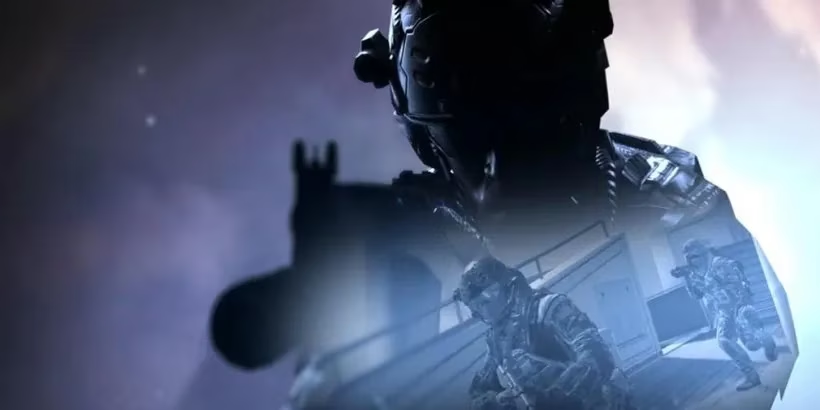
The announcement landed on Call of Duty's official Twitter page. In 2026, that sentence sounds almost quaint—Twitter is X now, and game delays are announced through a dozen corporate channels before breakfast. But in 2020, a simple post carried weight. Many people praised Activision for reading the room. Others, predictably, treated the comment section like a tantrum convention. The less said about that, the better. Some gamers wanted their Season 7. The world wanted justice. Only one of those things could wait.
What made the moment stick was not just the delay itself. It was the way the wider industry started to move. Sony pushed back its PS5 showcase from its originally intended date of June 4th. That was a big, expensive, spotlight-heavy decision. Zynga, one of the first mobile game studios to speak up, said it stood in solidarity with Black colleagues, employees, players, developers, and the broader community affected by racism and senseless violence. PocketGamer.biz pointed readers toward ways to support the Black Lives Matter movement. The message was clear: the gaming world could not pretend it existed in a bubble.
| Company | 2020 Move | 2026 Echo |
|---|---|---|
| Activision | Delayed Call of Duty: Mobile Season 7 indefinitely | Live-service games now routinely weigh real-world events before pushing updates |
| Sony | Postponed its PS5 showcase from June 4th | Platform holders treat global moments as launch-calendar factors |
| Zynga | Voiced solidarity with Black colleagues, players, and developers | Mobile studios face louder expectations around social responsibility |
By 2026, the industry has changed shape. Live-service calendars are more crowded, social media is more fragmented, and players are quicker to demand both content and conscience. Call of Duty: Mobile itself has kept evolving, as free-to-play shooters tend to do. Seasons come and go. Battle passes expire. But the 2020 pause remains a weird, important bookmark. It showed that even a mobile game—often dismissed as a dopamine machine with a storefront—can choose to sit still for a moment.
Honestly, that is not a small thing. A live-service game is a hungry creature. It wants updates, events, skins, and player attention. It does not enjoy silence. When Call of Duty: Mobile delayed Season 7, it let the creature go hungry. That took some nerve.
The decision also exposed a split that still exists in 2026. One camp sees games as escapism, a place to ignore the news. Another camp sees games as part of culture, made by people, played by people, and therefore tangled up in the same messy world as everyone else. The 2020 delay did not resolve that argument. It simply made the argument impossible to avoid. Players could still log in, shoot, and grind. But the pause reminded them that the real world had a timer too.
There is a temptation to reduce the whole episode to a PR move. Maybe it was. Maybe it was also a genuine acknowledgment that launching a new season during mass protests would have felt like throwing confetti at a funeral. Either way, the outcome mattered: a major mobile title stopped its hype machine. Sony moved a showcase. Zynga spoke up. Other companies followed, or at least cleared their throats loudly. The industry learned that silence can be a statement too—and usually not a flattering one.
For players in 2026, the lesson is less about Call of Duty: Mobile and more about timing. A game can be postponed. A season can arrive late. A battle pass can expire. Justice, however, does not come with a server maintenance window. The 2020 delay was not a cure for anything. It was a pause, a breath, a small corporate acknowledgment that some moments are bigger than a content roadmap.
And yet, life went on. The season eventually had its moment—indefinite delays in live-service land rarely mean forever. Players returned. The store refreshed. The world kept spinning. But the pause left a mark, like a thumbprint on a glossy screen. In 2026, it is still worth remembering that the games industry does not operate in a vacuum. It operates in a world where people live, protest, grieve, and hope.
So, yes: Call of Duty: Mobile delayed Season 7. It was a strange headline then. It is a historical footnote now. But footnotes have a way of showing up in the final exam. The question is not whether a mobile shooter can pause. It is whether anyone remembers why it did.